
Choosing the right AI use cases for telecom distribution can mean the difference between quick ROI and costly missteps. For telecom operators managing distribution networks across thousands of retailers, the question isn't whether AI will deliver value; it's where to start for maximum impact. The right entry point demonstrates ROI quickly, builds organisational confidence, and creates a foundation for expanding AI capabilities across your operations.
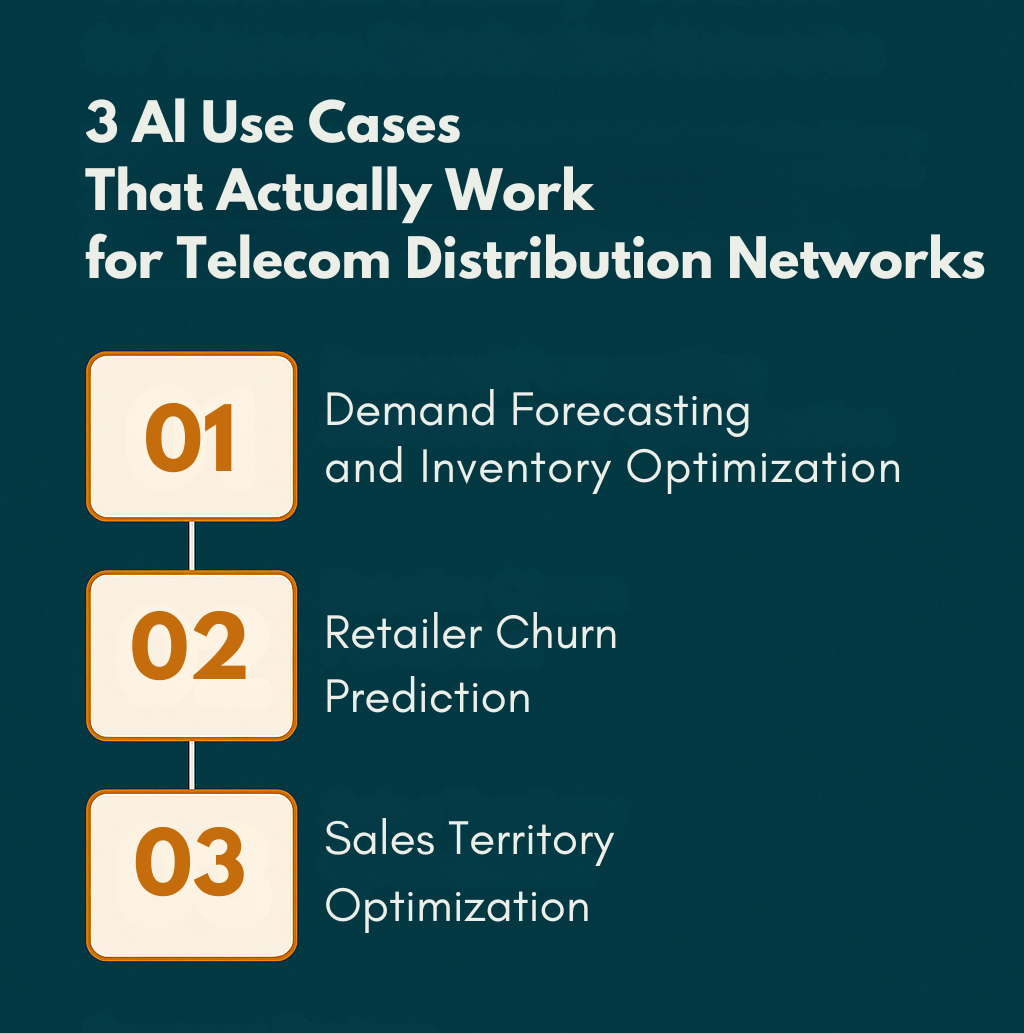
This guide explores three proven AI use cases that consistently deliver strong returns for telecom distribution: demand forecasting and inventory optimisation, retailer churn prediction, and sales territory optimisation.
AI Use Case 1: Demand Forecasting and Inventory Optimisation
The Challenge: Balancing Stock-Outs Against Excess Inventory
Every telecom operator managing retail distribution faces the same painful trade-off: stock too little and lose sales to competitors; stock too much and tie up millions in working capital. Traditional inventory management relies on simple reorder rules, seasonal averages, and manual adjustments—approaches that worked when product portfolios were smaller and markets more predictable.
Today's reality is more complex. Your retail network stocks dozens of SKUs, multiple SIM card types, handsets across price points, accessories, scratch cards, and digital service bundles. Demand varies by region, retailer type, day of the week, competitive activity, weather patterns, local events, and numerous other factors. No human can track all these variables across thousands of retail locations.
This is exactly where AI excels.
How AI Transforms Demand Forecasting
AI-powered demand forecasting analyzes millions of data points across your retail network to predict what products each retailer will need, when they'll need them, and in what quantities. Unlike rule-based systems that apply the same logic everywhere, AI learns the unique patterns of each retailer, region, and product category.
What AI detects that manual processes miss:
Retailer-specific patterns: Retailer A in an urban business district sells mostly postpaid SIMs and mid-range handsets during weekdays, while Retailer B in a residential area has weekend peaks for prepaid products and accessories. AI captures these micro-patterns across your entire network.
Product correlations: When handset sales spike, accessory demand follows 48-72 hours later. When customers buy certain SIM types, they typically return within 10 days for specific recharge denominations. AI identifies these correlations and adjusts forecasts accordingly.
Seasonal precision: Instead of crude "Q4 is busy" rules, AI learns that specific product categories peak at specific times—back-to-school for youth-oriented plans, holiday periods for handsets, month-end for airtime top-ups—and adjusts forecasts with precision.
Early trend detection: When demand for a specific product starts shifting—gradually increasing in one region, declining in another—AI detects these trends weeks before they're visible in aggregate reports, allowing proactive inventory adjustment.
Research from McKinsey & Company shows that companies using AI-powered demand forecasting achieve a 20-50% reduction in forecasting errors compared to traditional statistical methods, while reducing inventory costs by up to 20%.
Success Factors
What makes demand forecasting AI projects succeed:
- Clean SKU definitions: Ensure product codes are consistent and categories meaningful. AI can't learn patterns if products are miscategorized or codes change frequently.
- Realistic accuracy expectations: AI won't predict every product need perfectly. Target 15-25% improvement over current methods, not perfection.
- Feedback loops: When inventory managers override AI recommendations (for good reasons like local knowledge), capture that feedback to improve the model.
AI Use Case 2: Retailer Churn Prediction and Retention
The Challenge: Losing Retailers You Didn't Know Were at Risk
Retailer churn is expensive, and often invisible until it's too late. A retailer doesn't announce they're considering leaving your network; they gradually reduce orders, shift to competitor products, or simply stop engaging. By the time your sales team notices, the relationship is often beyond repair.
The cost isn't just replacing the retailer (recruitment, onboarding, training). It's the lost revenue during the weeks or months before a replacement reaches full productivity. It's the competitor who now has that retail touchpoint in your market. It's the customers who go elsewhere because their preferred shop no longer carries your products.
Traditional approaches to retention (quarterly business reviews, fixed visit schedules, reactive responses to complaint calls) miss the early signals that predict churn.
How AI Predicts Retailer Churn
AI analyzes hundreds of behavioral signals across your retailer network to identify at-risk relationships weeks or months before they end. The system learns patterns from historical churn, identifying combinations of factors that predict when a retailer is likely to leave.
Early warning signals AI detects:
Transaction velocity changes: Not just declining volume (which is obvious), but declining transaction frequency. A retailer who ordered weekly now orders every 10 days, then every 14 days. The trend suggests disengagement before volume drops significantly.
Payment behavior deterioration: Increasing payment delays—from 7 days average to 12 days, then 18 days—often precedes churn as retailers prioritize other suppliers or face financial stress. This is particularly true in market where operators work directly with retailers.
Seasonal anomalies: A retailer that typically increases orders during peak seasons but maintains flat volumes this year is likely disengaging or moving volume elsewhere.
Peer comparison divergence: When similar retailers (same territory, size, demographics) show growing sales but one stagnates, AI flags the outlier for investigation.
The power isn't in any single signal—it's in the combination. AI learns which patterns consistently precede churn in your specific network, creating retailer-specific risk scores that update continuously.
Success Factors
What makes churn prediction AI projects succeed:
- Actionable risk scores: Don't just provide a number—explain what signals triggered the alert so field teams understand the "why" and can address specific issues.
- Response capacity: Ensure sales teams can actually reach flagged retailers within 7-14 days. If calendars are booked solid for months, predictions lose value.
- Celebrate saves: Make successful retention visible. When a sales rep prevents churn with a high-risk retailer, recognize it. This builds organizational buy-in for AI insights.
Retention economics: Research consistently shows that acquiring a new customer is 5 to 25 times more expensive than retaining an existing one—a principle that applies equally to retail distribution networks.
AI Use Case 3: Sales Territory and Resource Optimization
The Challenge: Unlimited Opportunities, Limited Time
Your field sales teams face an impossible challenge: 30,000 retailers, infinite possible actions (visits, calls, promotions, training), and limited hours each week. How do they decide which retailers to visit? Which products to promote? When to intervene versus when to let retailers operate independently?
Most organizations default to simple rules: visit large retailers monthly, medium retailers quarterly, small retailers as needed. Or divide territories geographically and have reps work their assigned areas on rotation. These approaches are administratively simple but economically inefficient.
The rep visiting Retailer A (scheduled quarterly visit) might create $500 in incremental sales. But if they'd visited Retailer B instead (not scheduled, but showing early growth signals), they could have generated $3,000 in incremental sales. Multiply these misallocations across hundreds of reps and thousands of retailers, and the opportunity cost is substantial.
How AI Optimizes Sales Resources
AI analyzes historical outcomes—which visits, promotions, and interventions actually generated results—and combines this with real-time retailer signals to recommend where field teams should focus for maximum impact.
What AI optimizes:
Visit prioritization: Instead of fixed schedules, AI recommends visits based on the likelihood of a positive outcome. Retailers showing growth signals get attention to accelerate momentum. Retailers with early warning signs get preventive intervention. Retailers performing well and stably require fewer check-ins. Studies on sales force effectiveness show that data-driven sales organizations see 15-20% improvements in productivity compared to those relying on intuition alone.
Timing optimization: AI learns when interventions are most effective. Some retailers respond well to month-start promotions. Others show buying patterns around specific events or seasons. Reps get timing guidance along with visit recommendations.
Opportunity identification: AI flags retailers with untapped potential—those underperforming similar peers despite having favorable location, demographics, or market characteristics. These become priority opportunities for growth-focused interventions.
Resource allocation: At the territory level, AI helps sales managers balance their team across competing priorities—retention interventions, growth opportunities, maintenance visits, and new retailer recruitment—based on expected returns.
Success Factors
What makes sales optimization AI succeed:
- Intuitive mobile interface: Reps work in the field on phones. Recommendations must be simple, fast, actionable, not buried in complex dashboards.
- Explain the "why" with Rep autonomy: Don't just say "Visit Retailer X." Explain "Retailer X increased purchases by 30% last month and usually responds well to handset promotions—good opportunity for growth." Override flexibility is essential. Reps have local knowledge AI can't see.
- Quick wins: Ensure early recommendations prove valuable. If AI recommends 10 visits and 2-3 generate visible wins in the first week, rep buy-in follows naturally.
How to Choose the Right AI Use Case for Your Telecom Retail Network
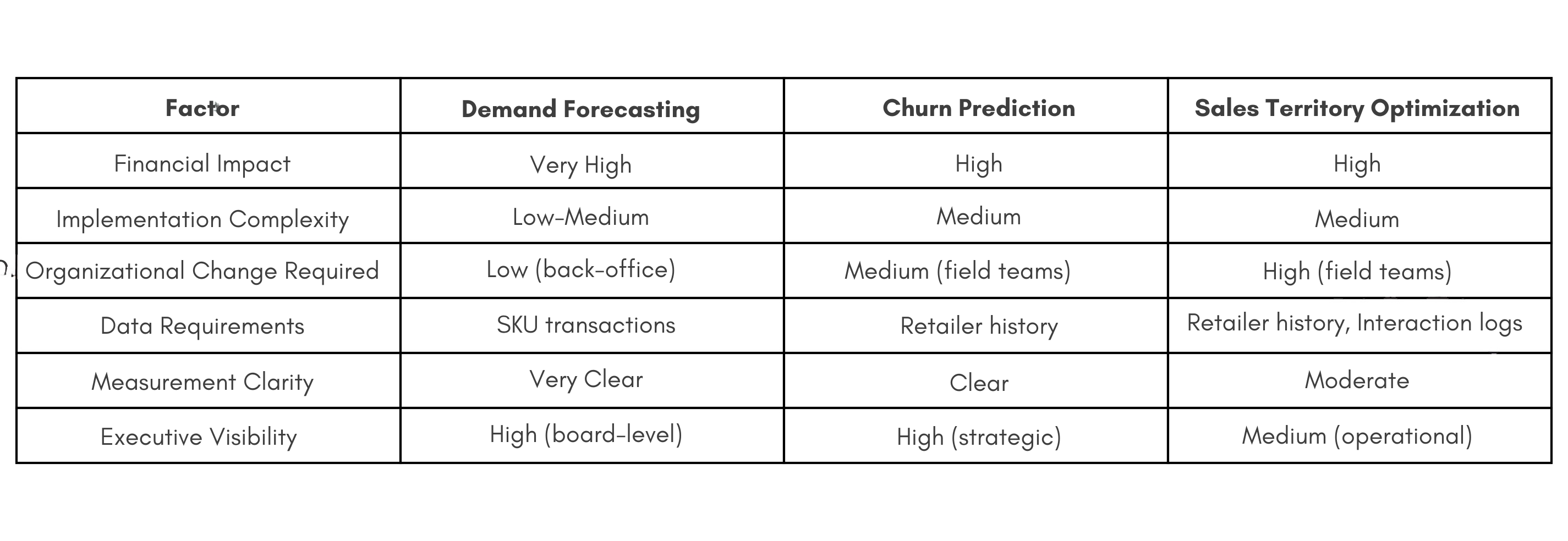
All three AI entry points deliver strong ROI, but which should you prioritize? Consider these factors:
The Pragmatic Approach: Don't Overthink It
Here's the reality. All three entry points lead to the same destination: a more efficient distribution operation. Success with any one use case builds organizational capability, confidence, and data foundation to expand to others.
The best entry point is the one that:
- Addresses your most expensive problem right now
- Has executive sponsorship and clear success metrics
- Has required data available (or easily capturable)
- Fits your organizational readiness for change
Pick your entry point. Define your pilot. Launch in 60 days.
Ready to Implement AI in Your Distribution Network?
Our team helps telecom operators define success metrics, assess data readiness, and launch AI pilots that deliver measurable ROI in 60-90 days.
To schedule a consultation to discuss your AI roadmap, Click Here
Other articles that may interest you:
About Estel:
Estel empowers telecom operators to modernise their sales and distribution through AI-enabled platforms covering recharge, mobile money, and inventory management.


